The Report Is Where the Work Starts
Most California boards and building owners have now been through at least one balcony inspection. The engineer or inspector has come and gone and the report is sitting in someone’s inbox. For many associations that feels like the end of the job. It is really the start of a construction project, with a deadline, a budget and a paper trail that buyers and lenders will ask to see.
This article picks up where the inspection leaves off. It is written from the construction side for boards, managers, condo owners and apartment owners. The legal points are brief context and your counsel decides how they apply to your building.
If you need the basics of the inspections themselves first, our balcony inspections page summarizes both statutes.
Which Law Applies to Your Building
California has two balcony laws and they split by ownership type. Their deadlines differ.
- SB 326 (Civil Code Section 5551) for condominiums. It applies to condominium projects with three or more attached multifamily units. The inspection covers balconies and the other exterior load-bearing elements the statute lists for which the association has maintenance or repair responsibility. A licensed structural or civil engineer or an architect inspects a random, statistically significant sample of them at least every nine years. The first inspection was due by January 1, 2025. Later inspections run with the reserve study. SB 410 amended the section effective January 1, 2026.
- SB 721 (Health and Safety Code Section 17973) for apartment buildings. It applies to buildings with three or more multifamily units and excludes common interest developments. The owner hires the inspector, who can be an architect, a civil or structural engineer, a licensed A, B or C-5 contractor with at least five years of multistory wood frame experience or a certified building inspector or building official. The inspector cannot be employed by the local jurisdiction. At least 15% of each type of element is inspected. The first inspection was due by January 1, 2026, after AB 2579 extended the original deadline by one year. Inspections then repeat every six years.
A newer association building has its own timing. Under Section 5551, buildings with permit applications on or after January 1, 2020 must be inspected within six years of the certificate of occupancy.
Section 5551 also lets local agencies adopt stricter rules, so check with the city or county.
Reading the Report
An SB 326 report has a required structure. Under Section 5551(e) it covers the current condition of the elements inspected and whether any condition is an immediate threat, their expected future performance and remaining useful life, recommendations for repair or replacement and a summary on the first page with counts of what was found. The report must be stamped or signed, presented to the board and incorporated into the reserve study.
Start with the first page, then go straight to the recommendations. Look for these things:
- What was sampled and what was not. The sample is a statistical sample. A problem found at a few balconies may well exist at others of the same design and exposure that nobody opened. The repair scope usually has to reach further than the list of sampled locations.
- How the recommendations are written. “Repair as needed” or “further investigation recommended” is not something a contractor can price. Mark every recommendation that needs more definition before it can be bid.
- Remaining useful life. This is the number that goes into the reserve study.
- Water. Most balcony deterioration starts with water getting past the waterproofing, the flashing or the door threshold. If the report points there, the repair has to fix the water path as well as the wood or steel it damaged. Our water intrusion investigation work is often where that path gets traced.
An inspection report may identify conditions and recommend repair or replacement, but it often does not provide the drawings, specifications, quantities and details needed for bidding, permits and construction. I spent years as a project manager and construction administrator working RFIs and resolving discrepancies between design teams and general contractors in the field. Most of those problems started with a scope nobody could build from.
When the Report Finds an Immediate Threat
Associations Under SB 326
If the inspector finds a condition that poses an immediate threat to safety, Section 5551(g)(1) requires a copy of the report to go to the association immediately and to the local code enforcement agency within 15 days. The association must take preventive measures immediately. That includes preventing occupant access to the affected element until repairs have been inspected and approved by the local enforcement agency. Under Section 5551(g)(2) the local agency may recover its enforcement costs from the association.
Apartment Owners Under SB 721
Under Section 17973, when the inspector finds an immediate hazard the report goes to the owner and the local enforcement agency within 15 days and the owner must take preventive measures immediately.
What That Looks Like on Site
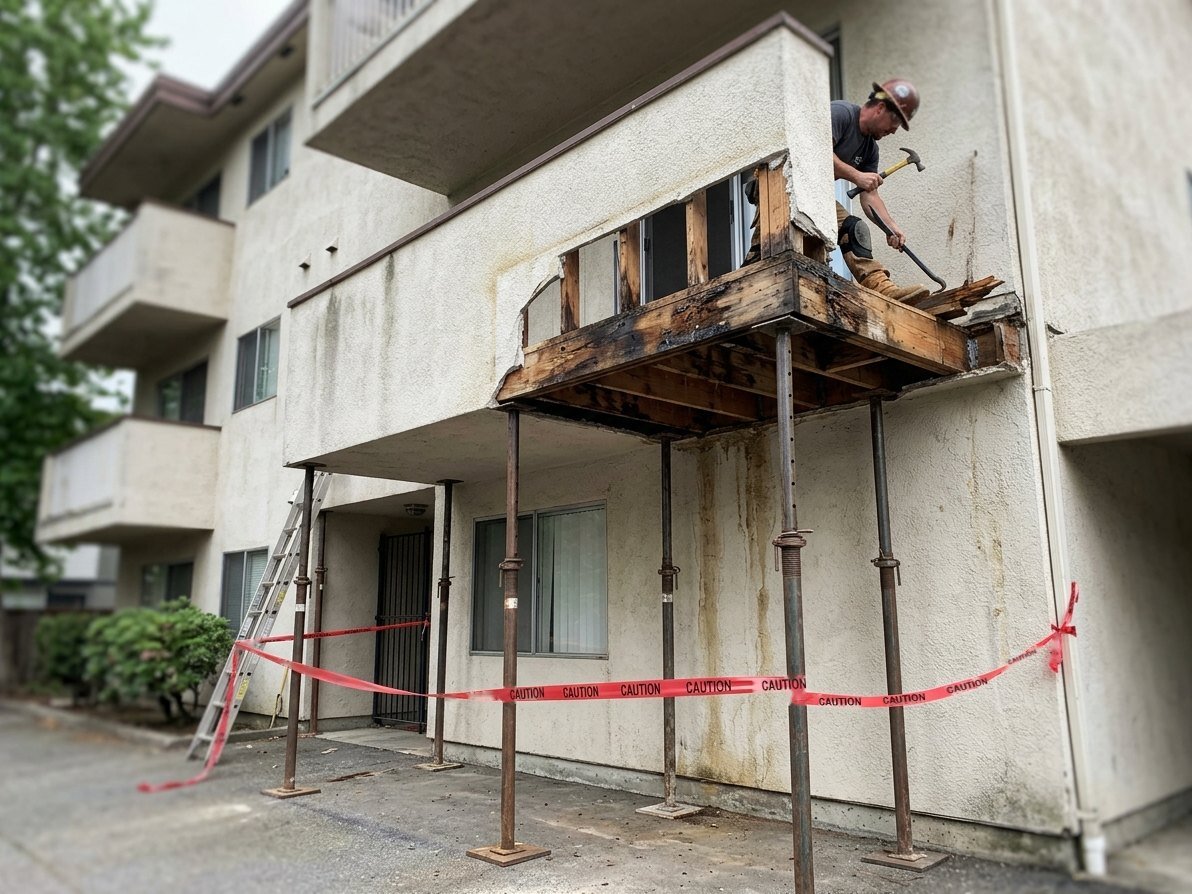
On site this means locked doors or barricades at the affected balconies, notice to the residents who use them and often temporary shoring designed by an engineer. Record each step with dates and photographs. Under Section 5551(g)(1), occupants stay off the element until the repairs are inspected and approved by the local enforcement agency. Procedures vary by jurisdiction, so coordinate reoccupation with that agency and plan the permitted repair and its inspections around it from the first day.
Repair Deadlines
Apartment Buildings Under SB 721
SB 721 sets a clock for non-emergency repairs. Under Section 17973 the inspector’s report is due within 45 days of the inspection. The owner must apply for a permit within 120 days of receiving the report. Repairs must be completed within 120 days after the permit is approved unless the local agency grants an extension. If the work is not done within 180 days, the inspector notifies the local enforcement agency. An owner who does not comply can face civil penalties of $100 to $500 per day and a lien on the property.
The statute also says how the work is done. Repairs are made by a qualified licensed contractor, follow the inspector’s recommendations, the manufacturer’s specifications and the California Building Standards Code and are done under permits.
A permit application within 120 days means the repair has to be designed well before then. Plan backwards from that date.
Associations Under SB 326
For associations the immediate-threat steps above are the firm part. Beyond them the report goes to the board, into the reserve study and onto the association’s maintenance plan. Section 5551(j) makes the association responsible for complying with the section and for ongoing maintenance and repair under its governing documents. Ask counsel whether the city has set a deadline that the state statute does not.
From Report to Finished Repair
A balcony repair is a small construction project and it should be run like one. This is the sequence we recommend:
- Confirm the extent. Have the engineer decide whether more openings are needed to define the full population of affected elements. A few more openings now cost less than a change order for every balcony found in the same condition.
- Get repair documents. The design professional turns the recommendations into drawings and specifications a contractor can price and a building department can review. That includes details for the waterproofing, flashing and door thresholds.
- Bid it properly. Send the same documents to every bidder. Ask for unit prices for the conditions you expect to find behind the finishes, such as replacing a joist or a length of rim board, so that hidden damage is priced before it is found. For apartment buildings, confirm the contractor fits the statute’s requirement for a qualified licensed contractor.
- Permit it. Submit early. For SB 721 buildings the 120-day permit clock controls the schedule.
- Oversee the work. Someone on the owner’s side should be at the openings, check the work against the drawings and track the unit-price quantities. Have the design professional observe the conditions that matter before they are covered up.
- Close it out. Get final inspections and put together the completion package described below.
I have managed capital projects as an owner’s representative on university work. The same controls apply at a much smaller scale here: a defined scope, a fair bid, a clear chain of approvals and a record of what was built. See what an owner’s representative actually does.
Who Pays
Associations
Section 5551(j) puts compliance on the association and ties ongoing maintenance and repair to the governing documents. Some CC&Rs assign balconies, decks or their surfaces to individual owners. Others keep them as common area. The documents for your association decide the split and counsel should read them before anyone sends an owner a bill.
The association’s share usually comes from reserves or a special assessment and the Civil Code limits what a board can do alone. Under Section 5605(b), without member approval the board may not impose special assessments that in total exceed 5% of the budgeted gross expenses for the fiscal year. It also may not raise regular assessments by more than 20%.
Section 5610 makes exceptions for emergencies. Two matter here. One is an extraordinary expense needed to repair or maintain the development where a threat to personal health or safety is discovered. The other is an extraordinary expense that could not reasonably have been foreseen when the budget was prepared. That second one requires a board resolution with written findings, distributed to members with the notice of assessment. Counsel should decide whether a given repair qualifies.
Apartment Owners
Under SB 721 the owner hires the inspector and the owner carries the repair.
When the Builder May Share the Cost
On a newer building, deterioration found in the inspection may raise questions about how the balconies were built. Whether there is a claim against a builder or design professional is for counsel to decide. Either way, document the conditions carefully during the repair. Our post on patent versus latent defects explains why the timing of discovery matters.
Selling a Unit and Getting a Loan
A report left in a drawer causes problems here. Owners hear it as “I can’t sell my condo because of SB 326.” Usually what stops the sale is an unfinished repair.
What a Seller Has to Provide
Since January 1, 2026, Civil Code Section 4525(a)(11), added by SB 410, requires the seller to give the buyer a copy of the report from the most recent inspection under Section 5551. Section 4525(a) also requires, among other items, the governing documents, the most recent documents distributed under Article 7 (the annual budget report and reserve disclosures), a statement of current regular and special assessments and any approved assessment changes not yet due. On request, the seller provides the board minutes from the prior 12 months. The exact documents in a resale package vary with the association’s records and the statutory disclosure process, so confirm the resale package with the association’s manager and counsel.
What Fannie Mae Looks For
Lenders that sell condo loans to Fannie Mae follow its project rules. Under Selling Guide B4-2.1-03, a project that needs critical repairs is ineligible until the repairs are completed and documented. Critical repairs include:
- material deficiencies that could lead to failure of a critical element or system within one year
- water intrusion or potentially damaging leaks
- advanced physical deterioration
- failure to pass a mandatory state or jurisdictional structural safety inspection
- unfunded repairs costing more than $10,000 per unit that should be undertaken within the next 12 months
If a structural or mechanical inspection was completed within three years of the lender’s review, the lender must obtain and review it. A special assessment tied to a critical repair that has not been remediated makes the project ineligible. A project under an evacuation order for an unsafe condition is ineligible until the condition is remediated and the building is deemed safe.
The review process is also changing. Fannie Mae Lender Letter LL-2026-03 retired Limited Review, so loan applications dated on or after August 3, 2026 go through Full Review or a Waiver of Project Review where one applies. Under Full Review, the minimum replacement reserve rises from 10% to 15% of annual budgeted assessment income for applications dated on or after January 4, 2027.
Each lender and its counsel decide how these rules apply to a given project. From the construction side, the best position is a finished repair with the paperwork to prove it.
Documenting Completion So It Counts
Lenders, buyers and the city all want to know whether the work is done. One organized package answers all of them. We suggest the package include:
- the inspection report and any follow-up investigation
- the repair drawings and specifications
- permits and final inspection records, plus for an immediate-threat condition any local enforcement agency approval or release that jurisdiction requires before access is restored
- a letter from the design professional confirming the work was completed in general conformance with the repair documents
- dated photographs of the conditions found and the work at each stage, keyed to unit or balcony numbers
- the contractor’s final invoice, lien releases and product and workmanship warranties
- the board minutes approving the work and recording its completion
Section 5551(i) requires associations to keep the reports for two inspection cycles. Keep the completion package with them. The next inspector and the next reserve study will both need it.
What to Do With This
If you sit on a board, read the first page of the report at the next meeting and get the recommendations into a scope with a schedule. Decide early whether the repair is funded from reserves or needs an assessment and have counsel look at Sections 5605 and 5610 before the notice goes out. Tell owners what was found and what the plan is, because buyers read the minutes.
If you own an apartment building, start from the SB 721 permit deadline and work backwards. Line up the design professional and a contractor as soon as the report arrives.
If you are selling a unit, ask the association for the inspection status and the completion package before you list.
Treat the report like the first document in a project file, not the last one in a compliance file. If you want help turning a report into a repair scope or overseeing the work, contact PCC. We work throughout California.
A Note on Sourcing
PCC is a construction forensics and construction management firm, not a law firm. Our part in a balcony repair is the building side: reading the report, defining the repair scope, bidding, oversight and documenting completion. The statutes and lending rules are here only as context. Rely on your counsel for how they apply to your association or building and on your lender for how its program rules apply to a loan.
Civil Code Sections 5551, 5605, 5610 and 4525 and Health and Safety Code Section 17973 were checked against the published text on the California Legislative Information site. The Fannie Mae material was checked against Selling Guide B4-2.1-03 as updated August 5, 2026 and Lender Letter LL-2026-03 dated March 18, 2026. Current as of September 2026. Local ordinances may add requirements not covered here.
This article provides general construction and regulatory context, not legal, insurance-coverage or lending advice. Laws, agency programs, lender requirements and local procedures change and may apply differently to a particular property. Consult your association’s counsel, the local agency and your lender before acting.