

State Guides
No-Damages-for-Delay Clauses: Pricing the Risk and Building the Record
Where delay comes from on real projects, how to price delay exposure and the project record every delay claim depends on.
Read the article →Texas takes a distinctive regulatory approach: no statewide contractor license, a mandatory pre-suit notice process under the Residential Construction Liability Act, and a statute of repose that recently changed. Here's the framework that shapes how PCC approaches both forensic and construction management engagements in this state.
Texas construction claims sit under two separate deadlines that run independently of one another: the general statute of limitations that applies to the type of claim being brought, and a construction-specific statute of repose that caps liability outright regardless of when a defect is discovered.
Because HB 2024 only shortens the repose period when a specific written warranty was actually provided, confirming whether a qualifying warranty exists (and its exact contract date relative to the June 9, 2023 effective date) is one of the first things worth establishing on a Texas residential matter. Getting this wrong in either direction can materially misstate how much time a claim actually has.
Chapter 27 of the Texas Property Code sets out a mandatory pre-litigation process for residential construction defect claims. It's a procedural gate, not a substantive time extension. The underlying statutes of limitation and repose above keep running throughout. The current process, as amended by House Bill 2022:
For attorneys and insurers, the practical effect is that a forensic evaluation on a Texas residential matter needs to be ready well before suit is filed. The 60-day notice period is exactly the window in which a contractor's inspection rights are exercised, so a forensic report that isn't ready to support that notice can put a claimant at a real procedural disadvantage.
PCC's forensic intake on RCLA matters is timed to have findings ready before the 60-day notice goes out, not after, so the pre-suit process works in the claimant's favor rather than against it.
Texas has no statewide general contractor license, a genuinely distinctive structure worth understanding on its own terms. There's no state board covering general contracting itself, unlike the trade-specific licenses described below.
Because there's no single statewide registry to check, confirming a contractor's actual regulatory status on a Texas matter means identifying the correct jurisdiction and trade classification first, then checking the applicable municipal or state-trade-board record.
Texas has no OSHA-approved State Plan for private-sector employers. Construction site safety on Texas private-sector job sites falls under federal OSHA jurisdiction directly, enforced under 29 CFR Part 1926 (Construction Industry Standards) through OSHA's Dallas and Houston area offices. State and local government construction workers are covered separately by the Texas Department of Insurance, Division of Workers' Compensation, not by OSHA. A forensic investigation touching an active Texas job site typically needs to account for federal OSHA requirements alongside local building codes and the standard of care in effect at the time of construction.
Forensic findings ready before the 60-day pre-suit notice goes out, so the RCLA's inspection and settlement window works in the claimant's favor.
Confirms whether HB 2024's six-year exception actually applies before assuming a matter has the full ten-year window.
No single statewide license to check means identifying the correct city, county or state trade board first, a step built into intake from the start.
Breach of contract, breach of warranty, fraud and DTPA claims generally carry a four-year statute of limitations; negligence claims generally carry a two-year statute of limitations. Separately, a statute of repose under Civil Practice & Remedies Code §16.009 bars most construction claims after ten years from substantial completion, though that period is shortened to six years for a detached one- or two-family home or a townhouse of no more than three stories if the builder provided a qualifying written warranty (House Bill 2024, effective June 9, 2023). These are general timeframes, not case-specific legal advice. Confirm applicability with counsel.
The RCLA (Chapter 27 of the Texas Property Code) is a mandatory pre-suit process for residential construction defect claims: the claimant must give the contractor written notice by certified mail at least 60 days before filing suit, the contractor has 35 days to inspect (up to three inspections), and the contractor then has 60 days from receiving notice to make a written settlement offer. The RCLA governs procedure; it does not extend the underlying statute of limitations or repose.
No. Texas has no statewide general contractor license. The Texas Department of Licensing and Regulation (TDLR) and the Texas State Board of Plumbing Examiners license specific trades (electrical, HVAC/refrigeration, plumbing), but general contracting itself is regulated only at the city or county level, and requirements vary significantly by jurisdiction.
Texas has no OSHA-approved State Plan for private-sector employers, so federal OSHA (29 CFR Part 1926 for construction) has direct jurisdiction on Texas job sites, enforced through OSHA's Dallas and Houston area offices. State and local government workers are covered separately by the Texas Department of Insurance, Division of Workers' Compensation, not federal OSHA.
This page is a general informational overview, not legal advice and does not create an attorney-client or expert-client relationship. Statutes and case law summarized above are subject to change and to case-specific exceptions. Confirm current applicability with qualified Texas counsel before relying on any deadline or standard described here.
Written by the same team that works these matters. Each piece is checked against the primary statute or the controlling decision rather than a secondary summary.
Where delay comes from on real projects, how to price delay exposure and the project record every delay claim depends on.
Read the article →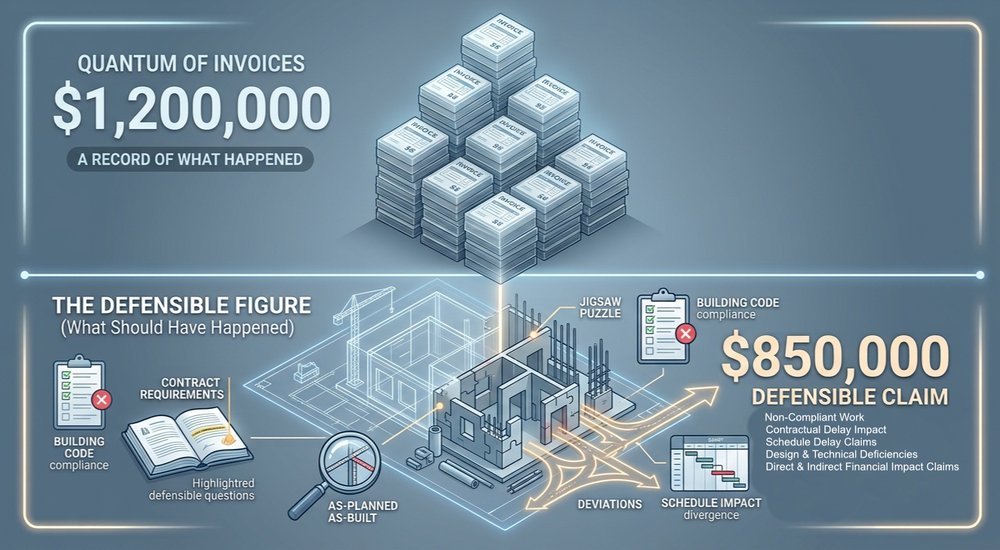
Why an invoice total is not a damages figure and what a defensible valuation has to account for.
Read the article →
Five checks from the investigator's side: method, evidence, alternative causes, photos and the author's discipline.
Read the article →All submissions are held in strict confidence and reviewed within one business day.