Start With the Stain
The scenario below is a composite, not any one project.
A homeowner notices the kitchen floor is soft near the sink base. The field adjuster pulls the toe kick and finds dark staining on the subfloor, rust on the shutoff valve and a musty odor. The report says “long-term leak” and the claim is closed on that basis. Months later a plumber’s invoice turns up showing that a failed dishwasher supply fitting was replaced the week of the loss. The fitting went into a dumpster.
Everyone on that file made a call about timing. Nobody took a measurement to support it.
Every water loss comes down to three questions about the building: where the water came from, what failed and let it out and how long it ran. The last one is what everybody wants answered. It is also the one the building is least able to answer. This article covers how an investigator works out source, cause and duration from the physical evidence and the records.
What the Seepage Clause Asks the Facts to Show
Scope the investigation to the questions the policy creates. That means the expert needs the actual form and endorsements before the site visit.
In ISO’s homeowners program, the familiar “weeks, months or years” language appears in the Limited Fungi, Wet or Dry Rot or Bacteria Coverage endorsement, HO 04 27 04 02, which modifies HO 00 03 and HO 00 05. For HO 00 03 it replaces paragraph 2.c.(5) with an exclusion for loss:
Caused by constant or repeated seepage or leakage of water or the presence or condensation of humidity, moisture or vapor, over a period of weeks, months or years unless such seepage or leakage of water or the presence or condensation of humidity, moisture or vapor and the resulting damage is unknown to all “insureds” and is hidden within the walls or ceilings or beneath the floors or above the ceilings of a structure.
ISO’s commercial Causes of Loss, Special Form, CP 10 30 09 17, uses a number instead. Its exclusion B.2.f covers continuous or repeated seepage or leakage of water and the presence or condensation of humidity, moisture or vapor “that occurs over a period of 14 days or more.”
The base homeowners form, HO 00 03 05 11, does not contain the “weeks, months or years” sentence. In that edition 2.c.(5) is the mold, fungus or wet rot exclusion. Long-term water damage is reached through the wear and tear, deterioration and corrosion exclusions, with an exception for accidental discharge or overflow from plumbing, heating, air conditioning or sprinkler systems and household appliances. Carrier and state versions vary, so the wording on the actual policy controls.
On site, those clauses become some combination of these questions:
- Source. Which system or component released the water and whether condensation or exterior water is the real source.
- Mechanism. Whether the component failed suddenly or progressively.
- Duration and pattern. How long water was released and whether it was continuous, repeated or a single event.
- Divisibility. Whether damage done early can be separated from damage done later. In Hicks v. American Integrity Insurance Co. of Florida, No. 5D17-1282 (Fla. 5th DCA 2018), a Florida appellate court read a 14-day clause in favor of coverage for the first 13 days, so a period-by-period damage analysis can matter.
- Concealment. Whether the leak and damage were physically hidden inside a wall, floor or ceiling. What any occupant knew is a fact question for others. The expert can speak to what was visible.
How any of this applies on a given file is for counsel. Our job is to answer the building questions accurately and to say plainly which ones the evidence cannot answer.
Find the Source Before Anything Else
Years of jobsite walks as a project manager taught me that water rarely shows up where it starts. It runs along top plates, follows pipe penetrations and wicks up bottom plates and drywall. It spreads across a slab under the flooring and drips from the first low point it finds. A ceiling stain below a bathroom may come from the tub drain, the shower valve, a toilet wax ring or a sweating cold line. Each of those behaves differently over time. Get the source wrong and every timing opinion built on it will be wrong too.
We work the source in roughly this order:
- Classify the system. Pressurized supply leaks run around the clock. Drain lines leak only when a fixture discharges. Appliance connections leak on the appliance’s cycle, condensate lines when the HVAC runs and exterior water with the weather.
- Follow the wetting pattern back uphill. Moisture readings should rise toward the source. A pattern that peaks at a plumbing wall points one way. A pattern that peaks at a window head or a roof penetration points somewhere else.
- Operate the system under observation. Run fixtures one at a time, fill and drain the tub, cycle the dishwasher and watch the cavity. Isolate supply branches and see whether the wetting continues.
- Rule out condensation. Sweating cold water lines, uninsulated ductwork in humid spaces and overflowing drain pans all mimic plumbing leaks. Condensation tends to follow the cold surface rather than a single point. Some forms name condensation in their own wording, so getting this wrong has consequences.
- Check for more than one source. An old repaired leak and a new failure in the same cavity are common.
How the Component Failed
Failure mode analysis is often the most useful work on a water file. It is also the step most often skipped. The failed part carries information about sudden versus progressive release that no stain can give you.
- Copper pinhole leaks can weep on and off before they open up, leaving a history of small wetting events at one spot.
- Braided supply connectors can fail abruptly under line pressure and release a large volume in a short time.
- PEX crimp or expansion fittings can fail at a poorly made connection years after installation. Sometimes that is a slow drip and sometimes a separation.
- Drain joints and slip nuts leak only when fixtures run, so the total wetting depends on use rather than calendar time.
A metallurgical or polymer examination can often distinguish corrosion, fatigue, manufacturing defect, installation error and overpressure. An examiner who can say whether the failure was progressive or sudden and whether the plausible leak rate fits the extent of damage is answering the question the policy asks. None of that is possible once the part has been thrown away.
Leak rate matters. A pinhole weep and a separated connector can wet the same subfloor, but the pinhole needs far longer to do it. Comparing what a failure could release with what the damage implies is one of the few checks that ties duration to something physical.
Map the Moisture Properly
Both the source work and the duration work rest on a good moisture map.
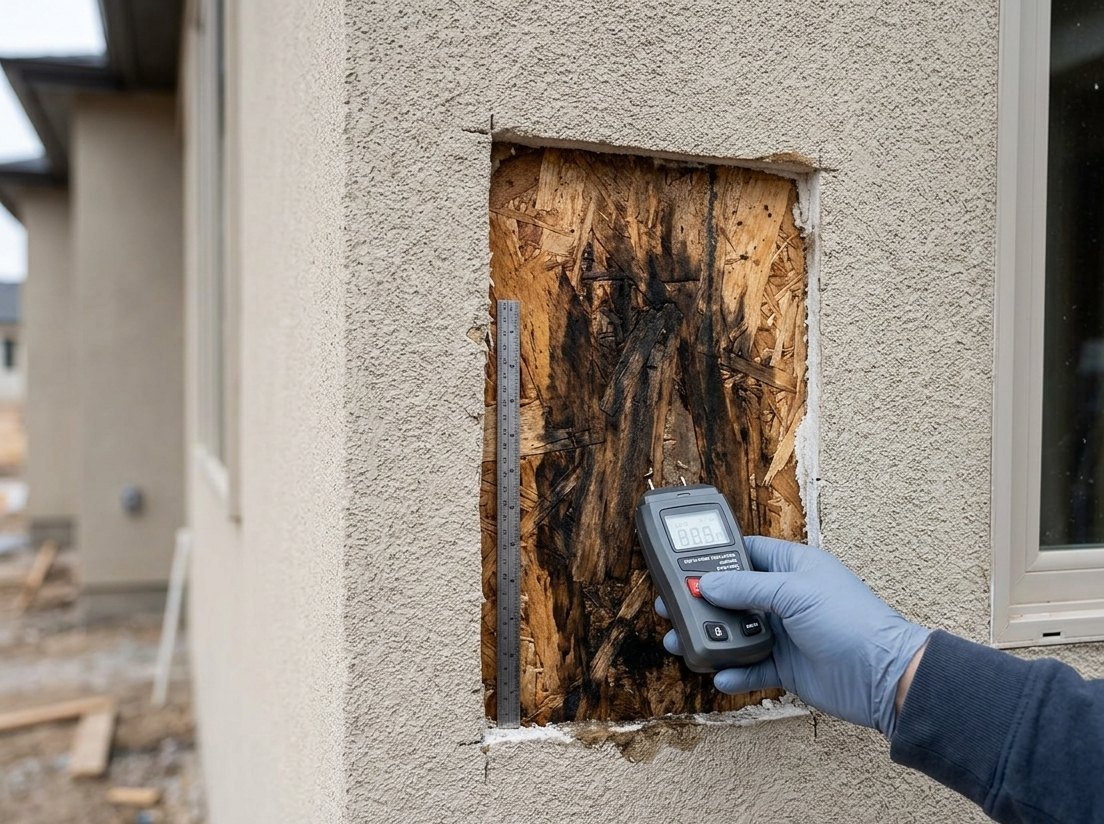
For wood, the reference points come from the USDA Forest Products Laboratory’s Wood Handbook (FPL-GTR-282, 2021). Fiber saturation averages about 30 percent moisture content. Interior wood at about 70 °F and 50 percent relative humidity equilibrates near 9 percent. The handbook puts reliable ranges at about 4 to 30 percent for dielectric (pinless) meters and 6 to 30 percent for resistance (pin) meters, with readings above 30 percent qualitative only. Resistance readings need species and temperature corrections. When the numbers will be contested, oven-dry moisture content from a physical sample is still the reference method.
On a water file, good practice looks like this:
- Grid, not spot readings. Scan with a pinless meter and confirm at depth with pins. Record the readings on a dimensioned sketch.
- Dry references. Read unaffected areas of the same materials so every wet reading has a baseline. Gypsum and concrete readings taken on a wood scale are relative only.
- Timing of readings. Note whether the water was shut off and whether drying equipment had run and for how long. A map taken after three days of dehumidification describes the drying rather than the leak.
- Thermal imaging as a guide. Infrared shows surface temperature. A cold spot can come from an insulation void or air leakage just as easily as from evaporation. Confirm every anomaly.
What the Materials Can Tell You
No single observation dates a leak. The expert pulls together independent indicators and checks whether they point to the same window of time. If they do not, the right answer is a range or no opinion at all.
Wood Moisture and Decay
The Wood Handbook states that serious decay occurs only above fiber saturation and that air-dried wood at or below 20 percent has a reasonable margin of safety. It also notes that incipient decay can be hard to recognize. That supports an inference in one direction. Confirmed decay in framing or subfloor means the wood sat above fiber saturation for a sustained period. It does not tell you how long that period was. Decay rates vary with species, temperature, the fungus and whether the wetting was continuous or cyclic. Turning decay depth into a number of weeks without published rate data for those conditions is guesswork.
Panels, Gypsum and Masonry
OSB and particleboard swell at the edges and delaminate. Paper-faced gypsum wicks, softens and loses its paper bond. Repeated wet-dry cycles leave layered tide lines where a single event tends to leave one. Efflorescence needs water to migrate through masonry and evaporate, so it suggests repeated or prolonged wetting. All of these show the pattern of wetting. None of them shows when it began.
Staining
Stain color depends on the water, the material and how often the area dried out. Dark staining is consistent with long exposure. It is also consistent with repeated short exposures or with an old, unrelated event. Use staining to map where the water went and look elsewhere for timing.
Corrosion
Corrosion rate depends on the metal, the coating, the water chemistry and the wetting cycle. Rust from an earlier leak that was repaired looks the same as rust from this one unless someone looks for the difference. I treat corrosion as supporting evidence and never as the deciding point.
Mold
EPA says that if wet materials are dried within 24 to 48 hours, in most cases mold will not grow. That is prevention guidance and it was not written as a way to date growth. The Wood Handbook notes that damp lumber in warm, humid weather can show mold and stain discoloration within 5 or 6 days. So visible growth shows the material stayed wet past a short window. It does not show how far past. ANSI/IICRC S520 (2024) and S500 (2021) govern remediation and restoration practice. Neither one is a protocol for dating growth.
Records Outside the Wall
Some of the best timing evidence is in accounts, devices and files that start disappearing the day of the loss. These are the requests we try to make in the first days of an assignment:
- Water utility data. Billing history compared year over year. Where advanced metering exists, interval reads may show a shift to constant flow that helps bracket a supply leak. A supply leak running around the clock should show up. A drain leak usually will not. Retention varies, so request it early.
- Leak sensors and connected devices. Smart shutoffs, water heaters and dishwashers log alarms, flow events and fault codes. Export the histories before accounts close or devices are thrown out.
- Photos. Phone metadata and earlier listing or inspection photos can show when the finishes were intact.
- Prior history. Purchase inspections, plumber invoices, HOA or building maintenance records and prior claim files often show an earlier leak at the same spot.
- Mitigation file. The restoration contractor’s first moisture logs, photos and demolition notes are often the only record of conditions before drying started.
- Occupancy. Travel, vacancy and how rooms were used all bear on how long water could run unnoticed and whether the damage was visible.
What the Building Cannot Tell You
A building keeps a fair record of where water went and roughly how wet things got. Its record of duration is poor.
- Few indicators have a clock. Decay, staining, corrosion and panel damage each have a minimum wetting period below which they are unlikely. None has a reliable maximum. They can support a minimum duration and little more.
- Intermittent leaks blur the picture. A drain that leaks only when the dishwasher discharges or a pinhole that weeps under pressure spikes can produce what looks like long-term damage from a short total wet time. How many days passed and how many hours the material was actually wet are two separate figures.
- Mitigation erases evidence. Anything that was not measured, photographed or kept before demolition is gone.
- Old damage looks like new damage. Without prior records, an earlier leak at the same spot can look identical.
Moisture readings, staining, corrosion, fungal growth, deterioration and repair history can inform a timing analysis. They do not by themselves establish an exact onset date.
In Nargizyan v. State Farm General Insurance Co., No. B342340, a California Court of Appeal opinion filed April 15, 2026 and certified for publication May 14, 2026, the court describes the carrier’s engineer as unable to estimate when the leak started, how long it existed or at what rate water escaped. As of September 23, 2026 it stands as a published Court of Appeal opinion. Check its later history before relying on it.
A defensible timing opinion names each indicator, states what it supports and what it cannot support and checks whether the independent lines of evidence agree. A statement like “at least 14 days” needs a stated reason behind it.
Where damage can be divided by period, the report should say which finishes and materials were likely ruined early and which damage needed longer exposure. It should make that split only where the evidence supports it. Early in my forensic career I prepared repair cost estimates for construction defect cases. A split like this works the same way a good estimate does: each line has to trace back to a condition someone actually observed and recorded.
An Inspection Protocol That Will Hold Up
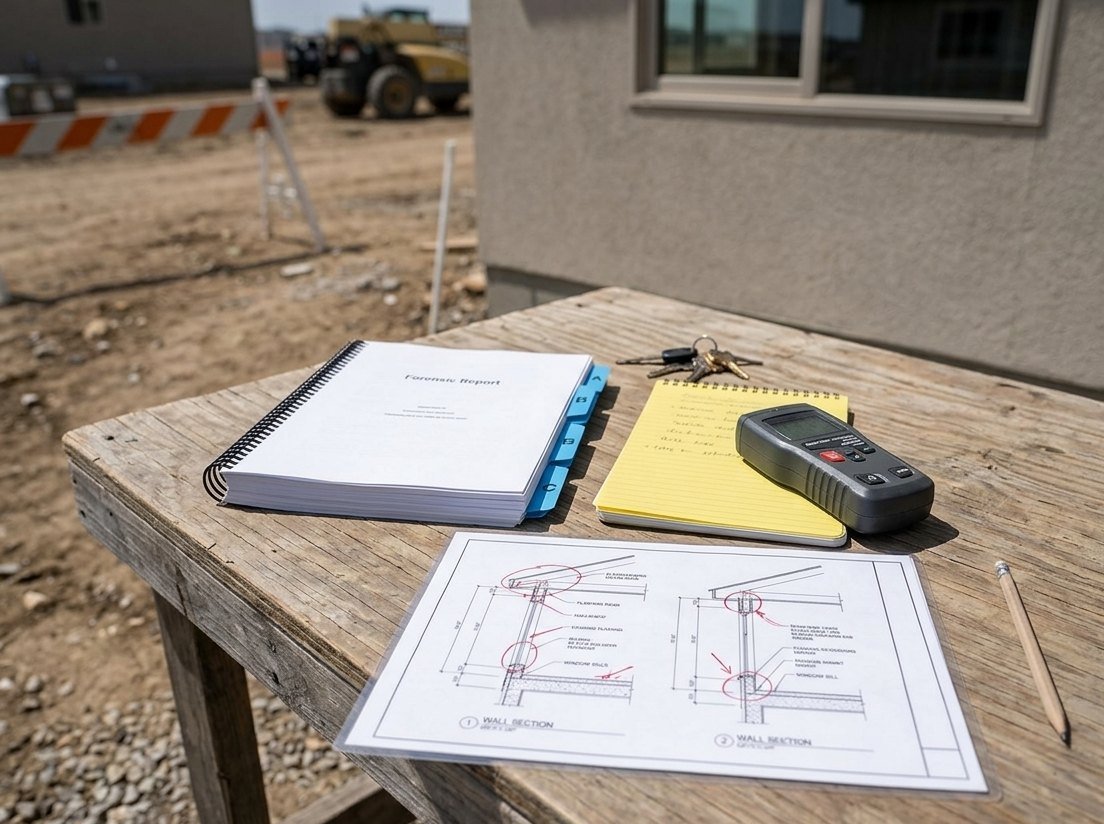
- Secure the source before repair. Photograph the component in place, remove it with the attached pipe, bag and label it and log every transfer. ASTM E1188 and ASTM E860 describe collection, preservation and notice to interested parties before destructive testing. See why ASTM standards matter in forensic investigation.
- Record conditions before drying. Get the mitigation contractor’s first readings and photos and note when the equipment started.
- Map, then open. Build a grid moisture map with dry references. Then open at the source, at the wetting boundary and at a dry control, photographing each location before anything is removed.
- Operate and isolate systems. Document which fixture or branch reproduces the wetting.
- Sample with a purpose. Take oven-dry moisture samples where readings will be contested and fungal identification for decayed wood. Sample for mold only when the result answers a causation question.
- Send the failed part to a lab under written chain of custody.
- Pull records the same week. Report timing as a range with its basis and separate damage by period where the evidence allows.
For how to read a finished report, see reading a forensic report before deposition.
What to Do With This
If you adjust water losses, the most useful thing you can do happens on the first visit. Photograph the source and then preserve it. Do not write “long-term” unless you can name the indicator behind it. Get the full endorsement schedule to the expert before the site visit, order utility history and device logs on day one and ask the mitigation contractor to keep the initial moisture logs.
If you manage claims for a carrier or represent either side, bring the expert in before demolition whenever duration will matter. Send the policy form and endorsements along with the building questions you need answered. Ask for the source, the failure mode, a moisture map with references, a timing range with its basis and a period-by-period damage breakdown where the form calls for one. A report that says “consistent with long-term leakage” and nothing more will not carry much weight. When you review someone else’s timing opinion, check the meter type, the reference readings and the drying history. Ask whether the failed part was examined and what rate data supports any duration figure.
My advice to owners and property managers is short. Shut off the water, photograph everything, keep the part the plumber removes and save the device alerts and water bills.
The inspection, photographs and preserved parts from the first week usually decide the timing question years later. That early fieldwork is the core of PCC’s construction forensics practice. When a water file needs it, contact PCC.
A Note on Sourcing
PCC is a construction forensics and construction management firm, not a law firm. Our role on water files is the building side: source, failure mode, moisture history and what the physical record can establish about timing. The policy forms and the two court decisions mentioned are here only as context for why that building work matters. Rely on your counsel for how any policy term or rule applies to a given loss.
Policy language was checked against ISO form copies filed with state insurance regulators. Carrier forms vary and ISO forms are revised, so confirm the edition and endorsements on the actual policy. Technical thresholds come from the USDA Wood Handbook (2021), EPA guidance and the published scopes of the IICRC and ASTM standards named. Plumbing failure behavior is described qualitatively from general practice. Current as of September 2026.
This article is a general informational overview, not legal advice and does not create an attorney-client or expert-client relationship. Rules and case law change. Confirm current applicability with qualified counsel in the relevant jurisdiction before relying on anything described here.