The Short Version
A construction expert’s opinion is only as strong as the investigation behind it. When an opinion gets challenged, the questions are rarely about the expert’s resume. They are about the work. When was the site inspected and what had changed by then? What was tested and to which standard? How were the sample locations chosen? Which other causes were considered and why were they ruled out? Can each conclusion be traced to something the expert saw, measured or read?
Think of a defect report built on one exterior walk, a leak opinion that never reproduced a leak or a repair estimate carried from four units to four hundred with no explanation. Each of those is an investigation problem first. They are also the easiest problems to prevent, because every one of them is decided in the field and in the project record months before anyone reads the report.
This article covers that work from the construction side: inspection timing, testing, sampling, alternative causes, the link between data and conclusions, qualifications and assumptions. It ends with a self-check and some practical advice for owners, contractors and carriers.
The Rule in Brief
In federal court, Federal Rule of Evidence 702 governs expert testimony. As amended effective December 1, 2023, the party offering the expert must show the court that it is more likely than not that the testimony is based on sufficient facts or data, is the product of reliable principles and methods and that:
the expert’s opinion reflects a reliable application of the principles and methods to the facts of the case.
The Supreme Court in Kumho Tire Co. v. Carmichael, 526 U.S. 137 (1999), made clear that this screening covers technical and experience-based opinions as well as laboratory science. It asks for “the same level of intellectual rigor that characterizes the practice of an expert in the relevant field.” For construction, the question becomes whether the expert did what a careful practitioner would do on a real project.
State courts apply their own evidence rules and tests and they do not all read the same way. Counsel decides how any rule applies to a given file. For the expert, the practical point holds everywhere: sufficient facts, a recognized method and a conclusion that stays inside what the method and the facts support.
Site Inspection Timing
Buildings do not hold still for an investigation. Between the event and the inspection, owners make temporary repairs, mitigation contractors remove wet materials, tenants move furniture over stains, roofers patch the obvious spots and another season of weather goes by. Every one of those changes erases or muddies evidence. A late inspection can still be useful. The expert just has to account for the gap.
Here is what that looks like in the field:
- Get in early. The first inspection should happen before repairs or demolition wherever the claim allows it. If repairs cannot wait, the expert should at least get the chance to document conditions and collect samples before work starts.
- Record what changed. The report should state the date of the event, the date of each site visit and what had been repaired, removed or altered in between. Mitigation records, repair invoices and the owner’s own photographs fill that gap.
- Inspect inside and out. Water enters from the exterior and shows up on the interior. A roof or wall opinion formed from one side of the assembly is missing half the evidence.
- Preserve what is removed. Cut samples, failed components and removed materials should be labeled, photographed in place, bagged and logged so the other side’s consultant can examine the same pieces.
- Photograph systematically. Wide shots to establish location, mid shots to show the condition in context and close shots with a scale reference. Keep the original files so the metadata survives.
Testing to Recognized Standards
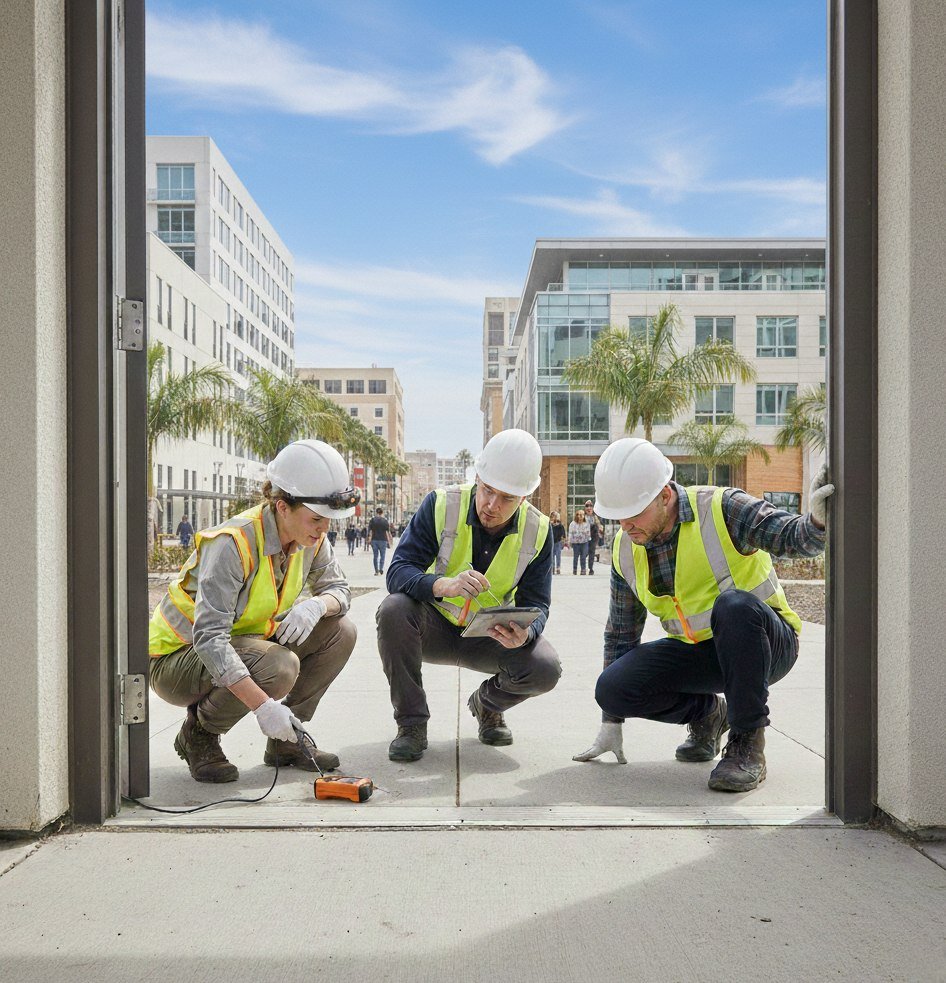
A walk-through shows the expert where to look, but confirming what is happening there takes testing. A leak opinion that never reproduced a leak or an impact opinion that never measured or sampled the damaged material rests on a mechanism nobody confirmed.
Recognized standards matter because they give the investigation an organized, checkable structure. ASTM E2128, the Standard Guide for Evaluating Water Leakage of Building Walls (current edition E2128-26), covers methods for determining and evaluating causes of water leakage of exterior walls. ASTM’s own summary notes that the guide’s sequential activities are meant to produce a complete evaluation program but that not every activity will be applicable or necessary for a particular evaluation.
In general practice a wall leak investigation confirms the water is coming through the wall, defines the scope, reviews the design and construction documents, inspects, tests to reproduce the leakage where conditions allow and reports the findings with their limitations stated.
The trap is citing a standard without doing the work it describes. A report that names E2128 and never tests an assembly where testing was feasible invites the obvious question. If an activity was skipped for a real reason (access, safety, the condition no longer existed), the report should say which one and why. See why ASTM standards matter in a forensic investigation for more on how standards frame field work.
The supporting record for any test should include the date and location, the procedure followed, instrument type and calibration where it applies, readings as taken rather than rounded into a summary, photographs of the setup and results and the name of the person who ran it.
Sampling Plans and How Far They Reach
On a large project nobody opens every wall, cuts every roof seam or tests every window. Experts sample and then project. That is sound practice when the sample is chosen with a plan and the report explains why the locations represent the rest. It fails when the openings were picked because those spots were already leaking and the results are then used to price repairs at every unit.
A defensible sampling plan usually does the following:
- Defines the population. Say what is being evaluated: all windows of one type, all balconies on the south elevation or every unit built by one framing crew. A plan cannot represent something it never defined.
- Groups like with like. Elevation and exposure, floor level, detail type, building phase, installer and product lot all affect performance. Locations should be drawn from each group that matters.
- Mixes complaint and non-complaint locations. If only distressed areas are opened, the results say nothing about areas that are performing.
- Is written before the openings. A plan written after the results are in will be read as a plan built to fit them.
- Matches the conclusion to the sample. Findings at three window openings support a conclusion about three window openings unless the plan explains why they stand for the rest. “Throughout the building” needs building-wide support.
When the budget or access will not allow a representative sample, the expert should give a narrower opinion rather than stretch the results further than they go.
Ruling Out Alternative Causes
Most building failures have more than one plausible explanation. Water at a window head could be the window, the flashing, the weather barrier lap, the sealant joint, a roof or deck above it or condensation. Cracked finishes could be shrinkage, settlement, overloading or a missing control joint. A causation opinion has to deal with each candidate the evidence raises, including the ones the expert does not favor.
Start by listing the alternatives at the beginning of the investigation. For each one, decide what observation or test would confirm or eliminate it and then report the result for every item on the list. The list should include causes raised by the other side’s consultant, the adjuster, the original design team or anything already in the project record. Design, workmanship, material defect, maintenance, normal wear and a specific weather event each leave different physical signatures and the investigation should look for them.
One case-specific example comes from the Eighth Circuit in Bliv, Inc. v. Charter Oak Fire Insurance Co., No. 24-3123 (8th Cir. Nov. 12, 2025). The owner’s engineer visually inspected a TPO roof nearly two years after a July 2021 storm. He did not inspect the interior damage, cut the roof or conduct testing. He proposed a mechanism he admitted was rare: small hail punctures in the membrane that were not readily visible. The court found he overlooked critical information in ruling out failed roofing seams and did not address important parts of another consultant’s work, which had pointed to a failed seam and a parapet wall defect. The exclusion of his opinion was affirmed.
That outcome turned on one record in one court and I would not read more into it than that. From the field side, though, a membrane sample and an interior walk could have tested the theory. Addressing the documented seam and parapet conditions could have answered the obvious alternatives.
Tying Every Conclusion to Observations and Data
Every factual statement in a report should point to a source. I spent years on the construction side as a project manager and construction administrator, handling RFIs, submittals, schedules and OAC meetings. I can tell you most of what an expert needs is already sitting in the project record, if the expert asks for it:
- Field records. Daily reports, superintendent logs, inspection cards, special inspection reports and third-party observation reports.
- Design and coordination records. Contract drawings, shop drawings, RFI logs and responses, submittal logs, product data and manufacturer installation instructions.
- Commercial records. Pay applications, change order logs, schedule updates and cost reports.
- Investigation data. Moisture readings and maps, test reports, laboratory results, sample logs and photographs with intact metadata.
- Post-completion records. O&M manuals, warranty letters, maintenance logs and service tickets.
Cost and schedule opinions follow the same rule. Early in my forensic career I prepared repair cost estimates as a consultant on construction defect cases. A repair figure needs quantities, a stated unit pricing source and a scope tied to observed conditions. Leave one of those out and the number has nothing to stand on.
A total cost figure (actual cost minus bid) is a last resort. Servidone Construction Corp. v. United States, 931 F.2d 860 (Fed. Cir. 1991), lists what it takes: showing that actual losses cannot practically be proven directly, that the bid was reasonable, that the actual costs were reasonable and that the claimant was not responsible for the added costs. Each of those is accounting and estimating work. See the quantum approach to construction damage valuation. Delay opinions need the same traceability to the as-planned and as-built schedules. Our piece on critical path method scheduling for delay claims covers that side.
A simple test: read each conclusion and ask where in the file it came from. If the answer is the expert’s general experience with no project-specific observation behind it, the conclusion is exposed.
Staying Inside One’s Qualifications
A general contractor can speak to means, methods, sequencing, trade practice and reasonable cost. The same witness saying a beam was undersized is offering an engineering opinion. An envelope consultant can explain how water got in. A structural question about what that water did to the framing may belong to someone else.
A good part of my construction administration work was resolving field and design discrepancies between design teams and general contractors. That work makes you very aware of where one discipline’s responsibility ends and the next one begins. Match every opinion in the draft report to the education, license or project experience behind it. If an opinion has nothing next to it, bring in a second expert for it rather than stretching the report.
Experts also inherit each other’s weaknesses. An estimator pricing an engineer’s repair scope is only as good as that scope. If the engineering sample was thin, the estimate built on it is thin too, however careful the pricing.
Documenting Assumptions
Every investigation rests on some assumptions: when water intrusion began, which contractor installed a given detail or what the original specification required where the documents are silent. That is normal. The problem comes when the assumptions are not written down.
In federal cases, Federal Rule of Civil Procedure 26(b)(4)(C)(iii) leaves unprotected attorney communications with a reporting expert that “identify assumptions that the party’s attorney provided and that the expert relied on.” Whatever the forum, the working practice is the same:
- State each assumption in the report. Say where it came from: a document, a witness, the client or counsel.
- Show which conclusions depend on it. If the start date of the leak changes, which findings change with it?
- Never convert an assumption into a finding. An expert who assumes the fact that decides the dispute and then reports it as something the investigation established has a foundation problem the moment that fact is contested.
- Test it where possible. If the record or the building can confirm or contradict an assumption, check it.
For how the role of a retained expert affects what gets shared, see testifying versus consulting experts.
A Self-Check Before the Report Goes Out
This overlaps with our guide to reading a forensic report before deposition. It works for a retained expert reviewing a draft or for a client reading one.
- Dates. Are the event date, each inspection date and every intervening repair stated?
- Method. Does the report name the standard or protocol used and show each step was done or explain why not?
- Sample. Can the expert explain in one paragraph why these locations were chosen and why they represent the ones not opened?
- Alternatives. Is every alternative cause raised by anyone named and dealt with using an observation or test?
- Sources. Does every factual statement trace to a document, reading, photograph or test result?
- Dollars and days. Is every cost tied to quantities and a price source? Is every delay tied to the schedule record?
- Scope of conclusions. Do the conclusions claim more than the sample and the testing support?
- Qualifications. Is every opinion inside the author’s discipline?
- Assumptions. Are they listed, sourced and linked to the conclusions that depend on them?
What an Expert Cannot Establish
Some questions cannot be answered from the building and a good expert says so. If a condition was repaired before anyone documented it, the expert can describe what the records show but cannot re-create what was not observed. If destructive testing was refused, the opinion about concealed conditions is an inference and should be labeled as one. A limited sample means a limited conclusion.
In my view, stating these limits plainly makes a report stronger. The other side gains very little by pointing out a gap the expert already disclosed.
What to Do With This
For owners, associations and other claimants, the most useful step is to bring the expert in before repairs start. Gather daily reports, submittal and RFI logs, warranty letters, maintenance records and every photograph taken since the problem appeared. Budget for testing and destructive openings up front instead of hoping a visual survey will carry the file.
Contractors, design professionals and manufacturers should pull their own project record early: inspection cards, installation photos, product lot information and correspondence about the detail in question. Ask your expert to walk the same locations the other side opened and to look for the alternative causes their report skipped. A defense opinion without inspection or testing has the same weakness in reverse.
Carriers and claims professionals can learn a lot from four questions before relying on a retained expert’s report. When did you inspect and what had changed? What did you test and to which standard? How did you pick the locations? What else could explain this? Where coverage turns on the cause of damage, those answers decide how much weight the report deserves.
My advice to anyone retaining an expert is to ask for the sampling plan and the list of alternative causes in writing before openings begin. Ask which opinions each expert will give and whether any fall outside their discipline. Confirm that samples and removed materials will be preserved. An expert who did not collect the facts at the right time cannot supply them later.
A Note on Sourcing
PCC is a construction forensics and construction management firm, not a law firm. The legal references in this article are included only as context for why the investigation work matters. Rely on your own counsel for how any rule applies to your situation. Our forensic work is the inspection, testing and analysis described above.
The Rule 702 text was checked against the Legal Information Institute and the U.S. Code. The Kumho Tire, Bliv and Servidone decisions were read from the opinions, Bliv from the Eighth Circuit’s own site. The ASTM E2128 designation and title were checked against ASTM’s own listing. The investigation sequence described above is general practice, not a restatement of the standard’s text. Current as of September 2026.
This article is a general informational overview, not legal advice and does not create an attorney-client or expert-client relationship. Rules and case law change. Confirm current applicability with qualified counsel in the relevant jurisdiction before relying on anything described here.