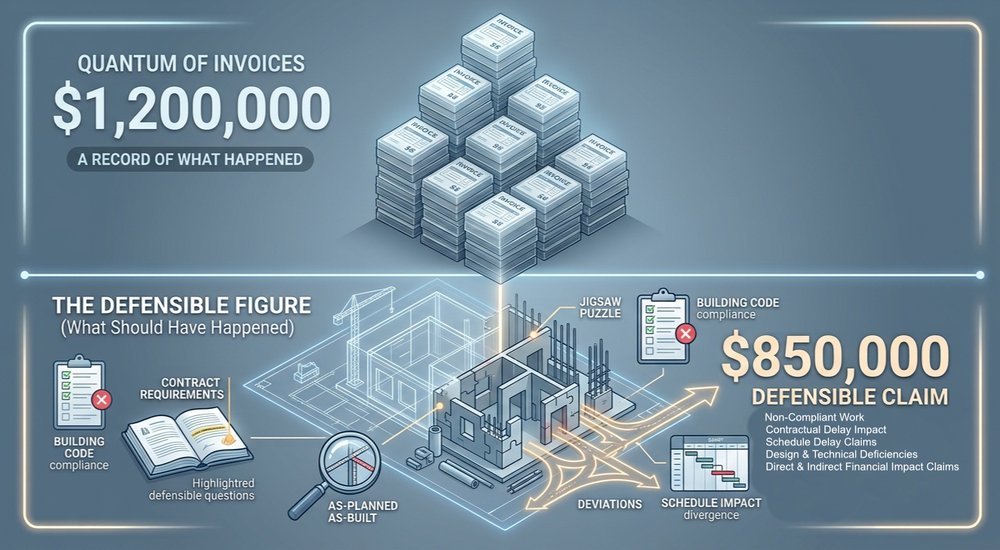
A damages number in a construction dispute is only as strong as the analysis behind it. It's common to see a claimed figure built from invoices, change orders and a general contractor's own accounting of costs incurred, a record of what happened. That's a starting point, not an answer. The harder, more defensible question is what should have happened under the contract, the applicable code and the standard of care. The analysis lives where the record and those requirements diverge.
In construction claims, quantum is the standard term for what a claim is worth, as distinct from entitlement, whether anything is owed at all. Our approach to quantum is to verify not just what happened, but what should have happened, against every dollar claimed. In practice, that means cross-referencing field conditions, contract documents and code requirements line by line, so every conclusion traces back to a documented source rather than an assumption carried over from the underlying invoices.
- Start from the contract and code, not the invoice. Before a claimed cost is evaluated, the underlying scope is established independently: what the contract actually required, what code compliance actually demanded. A cost can be real and still not belong in a damages claim if it wasn't required by either.
- Reconcile claimed costs against field conditions. Invoices and change orders get checked against what the physical record actually supports (field observations, photographs, prior reports), not accepted at face value because they were paid. Costs that trace cleanly to documented, necessary work are treated differently from costs that don't.
- Separate causation from cost. Two questions get kept separate: was this cost actually caused by the defect or delay at issue and is the amount claimed reasonable for the work involved. Conflating them is a common way a damages figure ends up overstated or under-defended.
- Document the trail, not just the total. The output isn't a single number: it's a number with a visible chain back to its source. When a figure can be traced line by line to a contract requirement, a code section or a documented field condition, it holds up under scrutiny far better than a total that can't be broken down.
A damages figure that can only be defended by pointing back at the invoices it came from is vulnerable the moment anyone reviewing it asks how any individual line item was verified. A figure built the other direction (from contract and code requirements forward to the specific costs those requirements justify) holds up because every step of the reasoning is visible and independently checkable. That difference tends to matter most when the figure is closely reviewed, whether by an insurer, an owner, an opposing consultant or anyone else weighing which number to believe.
This isn't a substitute for a full forensic accounting or legal analysis of a specific claim: it's the methodology behind how we build a defensible number when we're asked to. For how this fits into a broader forensics engagement, see our Construction Forensics services.
This article is a general informational overview, not legal or accounting advice and does not create an attorney-client or expert-client relationship. PCC is a construction forensics and construction management firm, not a law firm. Rely on counsel for how any legal rule applies to a specific claim.